2026-10-24
One EN71 report supports the squishy models and configurations within its documented scope—not every item in a supplier’s catalog. Buyers using SKU specific toy test reports should connect each purchase-order line to the tested sample, model references, materials, colors and applicable test sections before approving it. Several SKUs may share supporting evidence when their relationship is documented and technically justified; a shared category name, similar appearance or common factory is not enough to establish that connection.
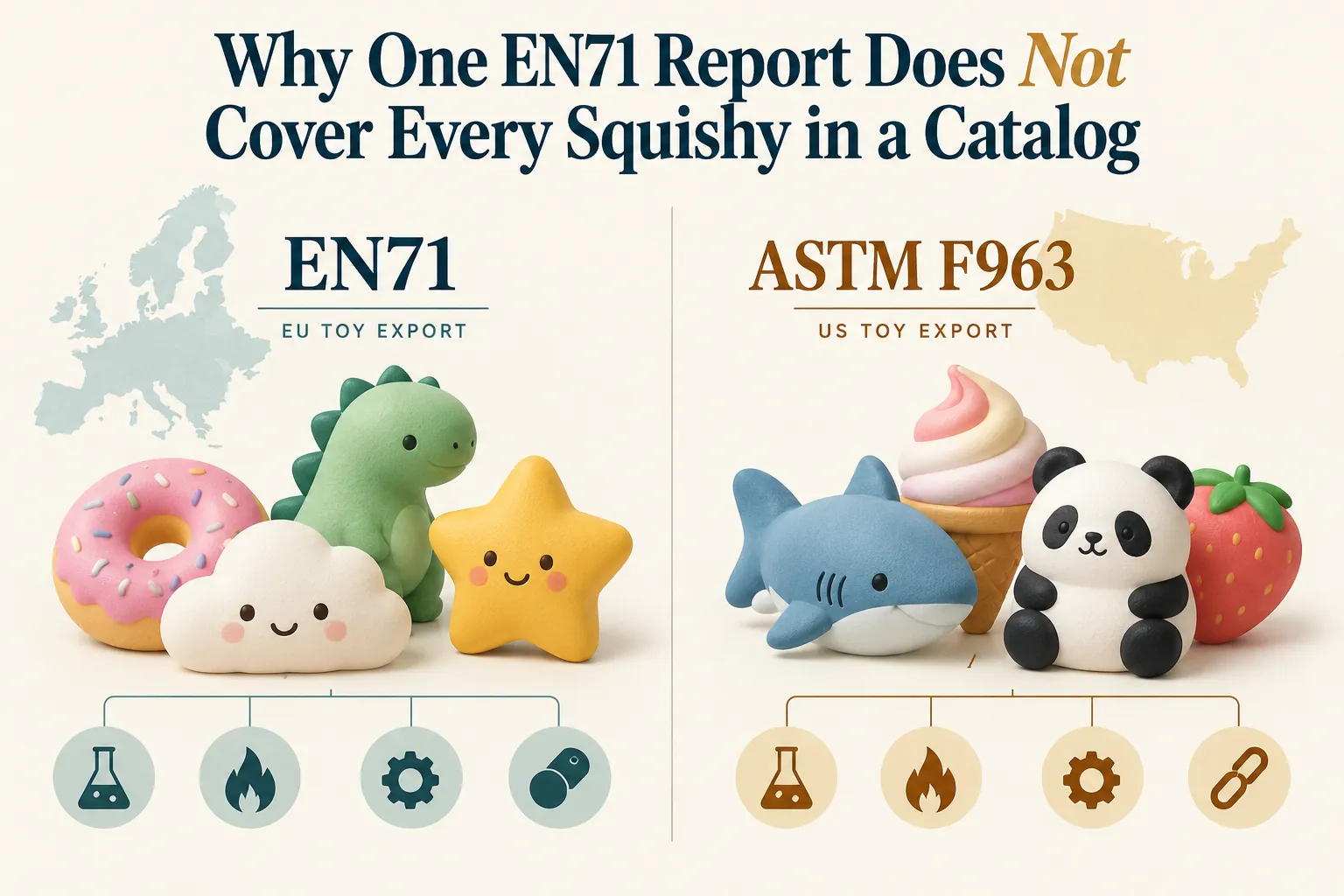
What does an EN71 report actually establish?
An EN71 report records results for identified samples against specified parts and editions of the standard; its title alone does not establish coverage of other models or untested requirements.
Read the sample description, photographs, model list, test sections, results and any exclusions together. A report limited to EN71-3 does not establish EN71-1 compliance. That distinction concerns the scope of the work, not whether the report looks official. EN71 report scope
The standard’s boundaries matter too. UNI describes EN 71-1:2026 as covering mechanical and physical properties and explicitly excludes electrical safety, which is addressed by EN IEC 62115. A squishy configuration with an electrical feature therefore needs a separate assessment of those aspects; an EN71-1 result is not an electrical-safety conclusion. UNI EN 71-1:2026
Model and configuration coverage matrix
| Same model and approved configuration | Match the purchase-order description to the report’s model references, sample photographs, dimensions and construction. Record the approved configuration revision and the report pages supporting the match. |
|---|---|
| Different model name or internal item number | Obtain a documented cross-reference between the commercial identifier and the tested model. Do not order a new test solely because an internal identifier changed; confirm whether the physical product changed. |
| Additional color, print or coating | Identify the changed material or finish and ask the laboratory to confirm whether existing evidence supports it or additional assessment is needed. A photograph showing one color is not, by itself, a coverage explanation for every color. |
| Changed material formulation or component supplier | Compare the approved material specification with the proposed replacement. Record the change and obtain a technical assessment of affected requirements before accepting the replacement under the existing report. |
| Different size, mold or attachment | Compare dimensions, construction, joints and detachable components with the tested sample. Require a documented assessment of the differences rather than treating visual resemblance as equivalence. |
| Added electrical feature | Assess the changed construction and electrical aspects separately. EN 71-1 does not cover electrical safety; do not extend its results to an added electrical function. |
| Different retail set or packaging | List every included item and compare the final packaging, instructions and warnings with the configuration reviewed. Check individual components and the assembled offering rather than relying only on the main toy’s description. |
| Later production lot | Connect the lot to the approved specification and record relevant changes. A golden-sample report does not, by itself, demonstrate that a later shipment matches that sample; this is not a blanket requirement to commission a new test for every lot. |
When can one report support several squishy SKUs?
Accept shared evidence when the covered models or variants are identifiable and the technical basis for grouping them is documented—not merely because they belong to the same catalog.
Start with the report’s model list and annexes. If commercial names differ from laboratory model references, create a controlled cross-reference. Then identify what is shared and what differs: construction, dimensions, materials, colors, coatings, attachments and intended use. Ask the laboratory to explain which results support which configurations and whether the differences call for additional assessment.
Keep the distinction clear: one internal SKU does not automatically require one separate report, and one report does not automatically cover every internal SKU. The useful purchasing unit is the documented configuration.
A factory audit answers questions about the factory and its processes; it does not replace product-specific safety evidence. Likewise, a supplier’s REACH declaration should be assessed with its supporting material evidence, not used as a substitute for the EN71 test scope.
Market and model document matrix
| EU purchase: EN71 evidence review | Record the exact ordered model and configuration, report reference, sample photographs, tested parts and editions, results, exclusions and the explanation for any grouped variants. Use this as the EN71 evidence portion of the market review, not as a declaration that all EU obligations have been satisfied. |
|---|---|
| US purchase: product-specific requirements | Identify applicable ASTM F963 sections and other applicable product-safety requirements for the actual model. Review age classification and relevant testing exceptions rather than assuming every squishy follows an identical testing route. |
| US purchase: certificate identity | Where a CPC is required, reconcile its product description with the ordered models and supporting records. CPSC requires enough detail to match the certificate to each product it covers and no others. |
| Same model purchased for both markets | Keep a common configuration record but separate the market-specific evidence and document decisions. Do not use an EN71 report as a CPC or treat a CPC as evidence of EN71 test results. |
What should trigger a coverage review before shipment?
Trigger a coverage review whenever the ordered or produced configuration differs from the approved reference; use the nature of the change, not the report date alone, to decide what further assessment is needed.
Record the previous specification, proposed change, affected models and lots, technical decision, and supporting evidence. A new color or material supplier should prompt a review, but the change itself is not proof that the toy is unsafe or that every test must be repeated. Ask the laboratory to identify the affected requirements and justify the next step.
Before shipment, compare the final product and packaging with the approved reference and reconcile the production lot with the purchase order. Visual and document checks help establish identity; they do not replace safety testing. Preserve the age classification and warnings assessed for each model instead of assigning one age label to the entire assortment.
If a safety failure is identified, stop release of the affected specification while its scope is investigated. Do not wait for the same failure to appear in another SKU.
What should a report-scope review request contain?
Request a marked coverage matrix that links every proposed purchase-order model to its approved configuration, supporting report pages and any required technical follow-up.
For a shortlist from Squishy Toys, submit the model list, complete reports with annexes, sample photographs, material and color specifications, packaging artwork, destination markets and proposed changes. Request one line per ordered configuration showing the identity match, tested scope, grouping rationale and disposition of any differences.
For US purchases requiring a CPC, include the certificate-to-model cross-reference in that review. CPSC’s instruction is precise: the description must match the certificate to each product it covers and no others. That is the discipline to apply to the entire purchasing file. CPSC CPC guidance
Sources
Put this into your procurement file.
Send the model, destination and approval scope to our team.
Request Audit Documents