2026-11-05
Approve an exclusive toy project’s tool transfer only when the identified tooling, approved configuration, movement authorization and receiving-site validation plan are documented. Settle the tool transfer questions before committing production: which drawings and inserts define the toy, what condition the tool is in, who controls access, and what evidence will release production after the move. Where a condition remains open, distinguish permission to transport the tool from permission to manufacture saleable goods; they are separate decisions.
Use a tooling approval record to connect each requirement to an observation, supporting record, responsible person and approval condition. The record supports traceability. It does not establish ownership, grant transfer rights or prove that an undisclosed change has not occurred.
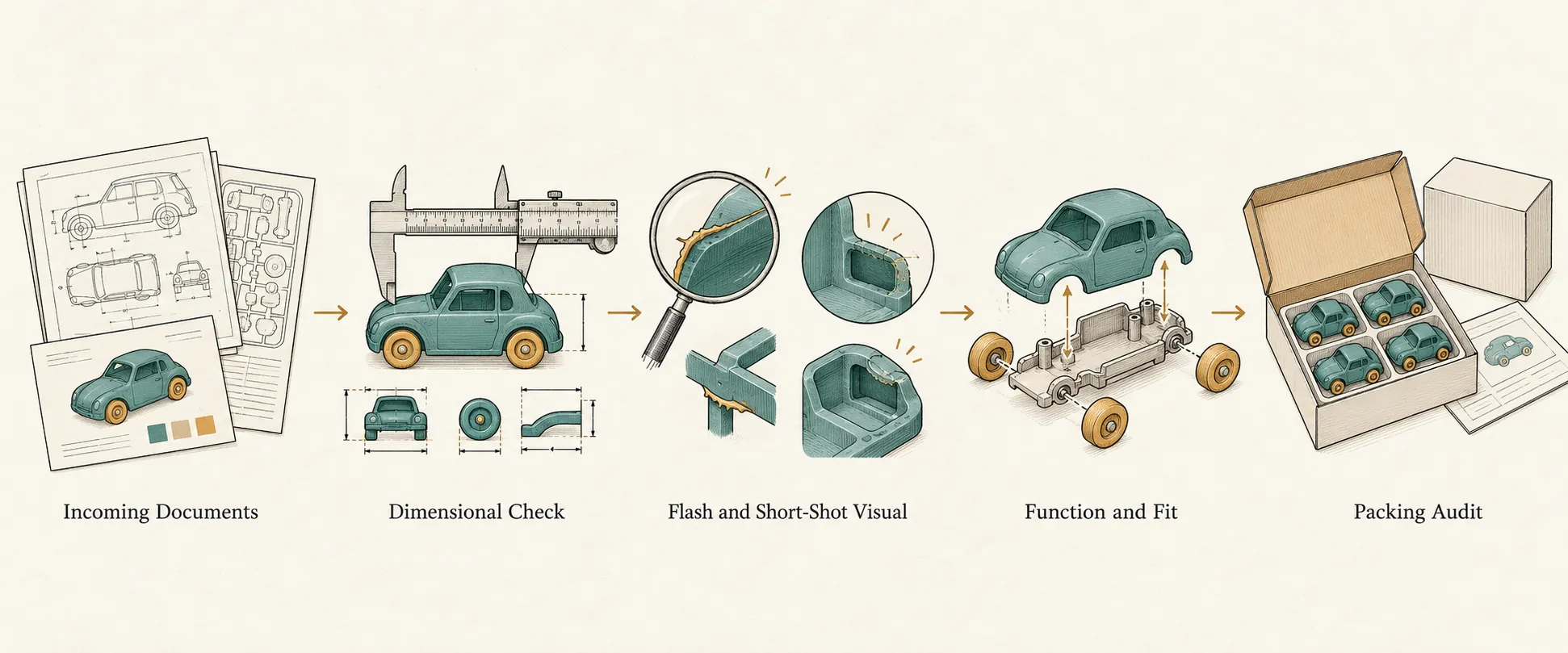
Who can authorize movement, and what does exclusivity cover?
Confirm movement authorization and exclusivity separately: physical possession of a tool is not sufficient evidence of either.
Request the agreed tooling terms and identify the owner, current holder, receiving site and parties authorized to release and receive the tool. Address payment conditions, maintenance, storage, inspection access, movement costs and end-of-life disposition. Record any unresolved restriction against the proposed transfer rather than assuming it disappears once transport is arranged.
Define the exclusive asset precisely. Does the agreement cover the complete mold, selected inserts, a particular product configuration, or use within an agreed territory and period? Identify any shared mold bases, mechanisms or components that remain outside that scope. Also settle access to drawings and the ability to repair or replace inserts; a tool that can move but cannot be maintained is a poor basis for an exclusive project.
These are recommended purchasing controls, not a statement of automatic contractual or statutory rights. Have the responsible commercial or legal reviewer confirm the project’s actual terms.
Which drawings and inserts define the approved toy?
Match the physical tool and its installed inserts to a named drawing revision and approved product configuration before accepting the handover.
Build a configuration list containing the tool identifier, drawing numbers and revisions, applicable cavities, installed and spare inserts, relevant material specification, component list and approved sample reference. Identify interchangeable inserts that change the toy’s appearance, branding, fit or function. A general description such as “exclusive toy mold” is not a configuration.
Separate document review from physical verification. A packing list may show that an insert is listed; it does not establish that the correct insert is installed or that its working surfaces are acceptable. Request identification photographs, an inspection of accessible features, and comparison with the relevant drawing. Record inaccessible features for a defined later check.
For the approved sample, retain its revision, approval record and distinguishing features. An approved sample is a production reference, not a guarantee of finished-goods quality; production control and appropriate pre-shipment inspection remain necessary. See the Sample & Product Development guidance.
What maintenance history and storage access should be confirmed?
Review maintenance history alongside the tool’s present condition, then assign responsibility for care before dispatch, during storage and after receipt.
Ask for repair entries, insert replacements, modifications and unresolved defects, with dates and supporting photographs where available. For injection molds, inspect relevant wear surfaces, vents, alignment features, ejectors and cooling connections. Worn inserts, blocked vents and alignment defects can change the molded result; the maintenance record should help identify where closer inspection is warranted.
A repair entry is evidence of a recorded intervention, not proof that the repair remains effective. Conversely, an incomplete maintenance log does not by itself establish that the tool is unusable. Record the uncertainty and specify a focused condition inspection or trial.
Confirm the storage address, custodian, preservation arrangements and access procedure. Name who can authorize inspection, opening, maintenance and collection, including any notice or release conditions. If a video inspection is used, request visible tool identification and views of the relevant areas; a closed crate does not establish internal condition.
Agree who documents packing condition, protects exposed surfaces and connections, checks the shipment on arrival, and handles damage or discrepancies. Keep the dispatch and receipt observations distinct.
How should you validate the tool after transfer?
Validate the received tool against the approved configuration and an agreed trial plan before releasing saleable production.
Start with receipt reconciliation: check the tool, inserts, spares and documents against the dispatch list, and record transport damage or differences. Then confirm that the receiving equipment and setup are suitable. For injection molds, the proposed compatibility review should address mounting, ejection, cooling connections and the intended molding process.
Run first-off samples using the agreed material and documented setup. Compare relevant dimensions, appearance, assembly fit and function with the drawing requirements and approved sample. Where cavities or alternative inserts produce distinct parts, define how each will be represented in the checks. Acceptance limits should come from approved specifications or explicitly agreed buyer criteria—not an improvised tolerance presented as a safety standard.
Keep this commercial validation separate from safety testing and report review. Request reports matched to the actual model and construction, and have the responsible compliance reviewer assess whether the transferred production configuration remains within their scope. Do not mark a tool “certified” merely because an earlier product sample had a report.
Close the trial’s deviations, approve the resulting production reference and retain the production-control and pre-shipment inspection requirements. Receiving the tool successfully is a logistics milestone, not a finished-product approval.
Tooling approval record
| Project identity and record revision | Enter the project name, buyer’s model/SKU reference, product configuration, destination market, record identifier, revision and preparation date. Identify the exact transfer covered. |
|---|---|
| Tool identity and custody | Record the tool identifier, identification photographs, current holder, dispatch location, receiving site and intended custodian. Reconcile these details at receipt. |
| Authorization and exclusivity | Reference the reviewed agreement and movement authorization. Record the scope of exclusivity, shared assets, payment or release conditions, and the reviewer responsible for confirming the terms. |
| Drawings and approved configuration | List the approved drawing numbers and revisions, applicable material and component specifications, and approved sample reference. Compare the documented target with the tool and resulting parts. |
| Installed inserts, spares and wear parts | List required insert identities, installed positions, alternatives and spares. Record what was physically checked, what was only listed in documents, and any remaining verification. |
| Maintenance history and present condition | Reference recorded repairs, replacements and modifications. Record observed wear or damage separately from proposed inspections, cleaning or repair, with an assigned maintenance owner. |
| Storage and access | Record the location, custodian, preservation requirements and agreed inspection, maintenance and collection arrangements. Identify who authorizes access and any release conditions. |
| Dispatch and receipt | Specify the packing list, protection requirements and condition evidence. Record dispatch and arrival observations separately, including shortages, damage and the person responsible for resolution. |
| Receiving-site setup and validation | Reference the equipment compatibility review and trial plan. State the intended material, configuration, checks and acceptance criteria; attach actual results and deviations after the trial. |
| Product report review | Identify the model, construction and report references reviewed by the compliance owner. Record the review conclusion and any further assessment or testing action without treating tool possession as approval. |
| Decision and permitted activity | Select approve, approve with conditions, or withhold approval. State explicitly whether the decision permits transport, trial operation, saleable production, or only a defined subset of those activities. |
| Responsible approval and date | Name the authorized approver for each applicable commercial, technical, quality and compliance decision. Record the decision date and the exact record revision approved. |
| Conditions and follow-up closure | Give each condition an owner, due date and required closure evidence. Record the closure reviewer, closure date and final production-release decision; retain superseded revisions. |
When should you approve, conditionally approve or withhold?
| Approve the transfer and production release | The hypothetical record establishes authorization, reconciles the received tool and inserts to the approved revision, and closes the agreed validation and report-review actions. Approve only the named configuration and activities. |
|---|---|
| Approve movement with a production hold | Movement authorization and custody arrangements are confirmed, but a spare insert listed in the handover documents has not been physically reconciled. Permit transport only if the discrepancy can be controlled; assign receipt verification and any required trial as conditions before production release. |
| Withhold movement approval | The current holder’s authority to release the tool remains unresolved. A matching approved sample may still be useful technical evidence, but it does not settle release authorization. Resolve that issue before dispatch. |
| Withhold production release after arrival | The tool arrives as listed, but first-off parts do not meet the approved configuration. Retain the receipt evidence, document the deviation and require correction and revalidation before approving saleable production. |
Tooling review request
Request a tool-identified handover review against the proposed drawing revision before committing the exclusive project.
Send the tooling approval record with the drawing and insert list, maintenance history, storage and access terms, movement authorization, and proposed receiving-site trial plan. Request an audit-document review and tool-identification video inspection, with each finding tied to an evidence reference, action owner and release condition. Route the completed record to the named approvers before production is released.
Put this into your procurement file.
Send the model, destination and approval scope to our team.
Request Audit Documents