2026-10-31
Release toy packaging for final assembly only when the inspected lot matches the current approved product configuration, artwork, destination-market file, and packing specification. Inspecting toy packaging before final assembly means checking revision, SKU, barcode, warnings, country scope, pack count, and model segregation before components reach the packing line. Hold affected packaging when an identity, labeling, destination, or quantity mismatch remains unresolved; record the evidence and correction needed rather than treating a readable barcode or familiar box as approval.
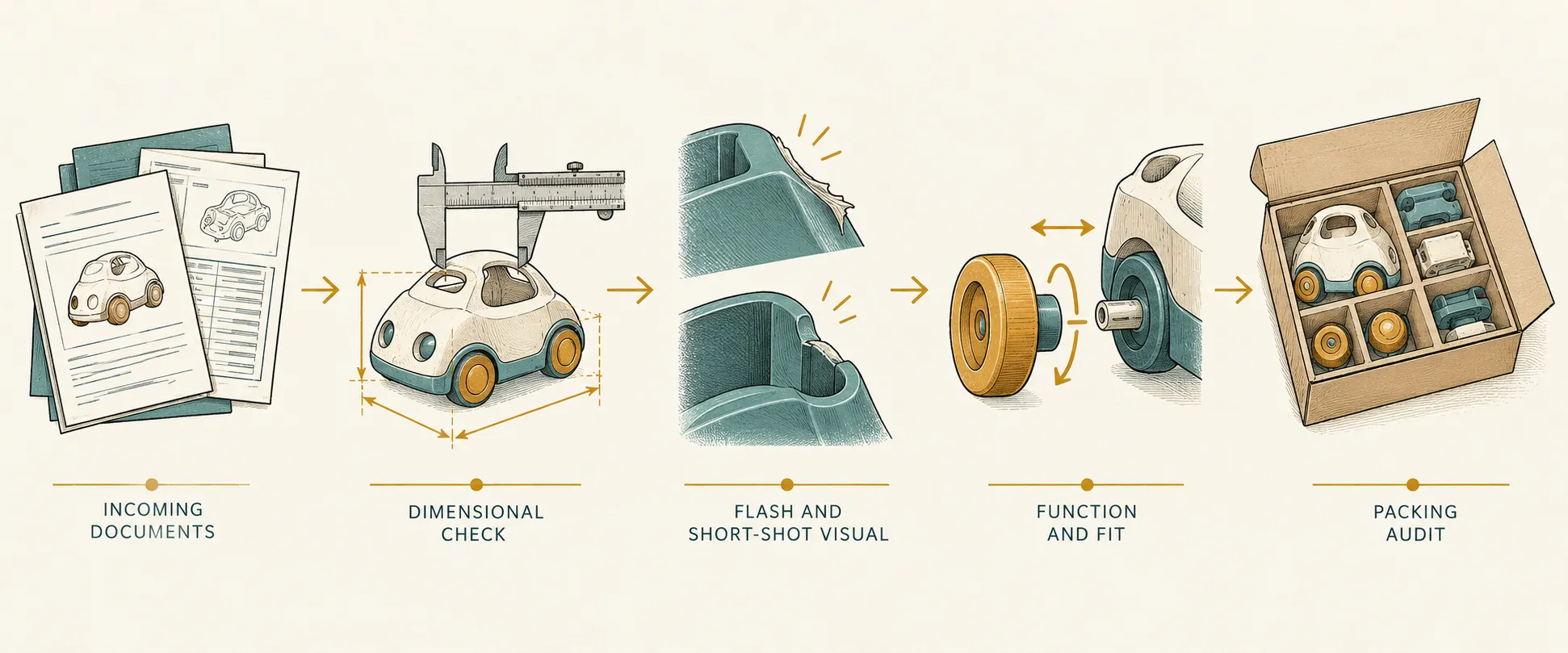
Which reference controls the packaging inspection?
The controlling reference is the current configuration approved for the exact order—not a catalog photograph, an old sample, or the most recently received email attachment.
Use the current SKU record to establish product identity and catalog packaging fields, then connect it to the purchase order, approved artwork revision, destination-market file, and packing specification. A catalog record is not, by itself, approval of warning text, barcode assignment, artwork revision, or assortment contents. If these records disagree, hold the affected packaging until the responsible owner resolves the conflict in a controlled revision.
This applies the controlled-reference approach described in the Pre-shipment inspection checklist at an earlier production gate. That source addresses substantially completed goods; the checklist below is a proposed buyer control before final assembly, not a statutory inspection procedure.
What belongs on the pre-assembly packaging inspection checklist?
| Inspection identity and reference control | Target/reference: Purchase order, exact product identifier, SKU-record revision or retrieval date, packaging supplier/job reference, lot identity, component types, artwork file/revision, and destination. Proposed check: Confirm that every reference describes the same ordered configuration. Observation to record: Actual lot labels, quantities presented, document identifiers, and inspection date. Hold trigger: Conflicting identities or no agreed controlling version. |
|---|---|
| Artwork revision | Target/reference: Approved artwork filename, revision, and approval record. Proposed check: Compare all printed panels, inserts, labels, and carton marks with that file. Observation to record: Revision printed on the component, where present; otherwise, the print-job reference and evidence linking it to the approved artwork. Attach photographs of differences. Hold trigger: Superseded graphics, text, layout, or an unresolved version mismatch. |
| SKU and product identity | Target/reference: Product identifier on the purchase order, current SKU record, and approved artwork. Proposed check: Compare printed identifiers and descriptions, including model or variant distinctions. Observation to record: Exact printed identifier and the component on which it appears. Hold trigger: Another model's identifier, an incorrect description, or inconsistent identifiers across packaging components. |
| Barcode | Target/reference: Approved encoded identifier and its product mapping in the buyer's item file. Proposed check: Inspect print legibility, scan the physical print, compare the decoded value with the approved value, and confirm its item mapping. Observation to record: Human-readable digits, decoded value, mapped item, scanner used, and result. Hold trigger: Wrong identifier, wrong item mapping, or an unreadable scan under the agreed inspection method. |
| Warnings and instructions | Target/reference: Compliance-approved warning and instruction text, language versions, and placement for this product and destination. Proposed check: Compare wording, symbols, language, placement, and legibility with the approved file. Observation to record: Actual text or clear photographs, affected panel, and each discrepancy. Hold trigger: Omitted, altered, obscured, or wrong-language content relative to that file. |
| Country scope | Target/reference: Destination countries on the order and the corresponding approved market file. Proposed check: Match the intended destination with the approved language combination, market-specific markings, and importer or tracking information specified for that configuration. Observation to record: Actual destination version and printed details. Hold trigger: Packaging assigned to another market or unresolved destination coverage. |
| Pack count | Target/reference: Approved definition of one saleable unit, contents per unit, units per inner pack, and units per master carton. Proposed check: Compare printed count claims and packing layouts with those definitions. Observation to record: Count printed at each level and counts from any trial pack actually assembled. Hold trigger: Count mismatch or an undefined counting unit. Do not record a final packed-carton count before packing has occurred. |
| Mixed-model and assortment control | Target/reference: Authorized model, variant, or assortment list and its component quantities. Proposed check: Inspect storage segregation, bundle labels, issued packaging, and line-clearance status for obsolete or unrelated components. Observation to record: Component identities and locations checked, plus any mixing found. Hold trigger: Unauthorized models, wrong assortment quantities, or unidentified packaging mixed into the lot. |
| Packaging fit and printed-information visibility | Target/reference: Approved packaging sample or drawing for the exact configuration. Proposed check: Fold a sample and trial-fit the intended contents where practical; inspect closure, label adhesion, and whether folds, seams, or contents obscure printed information. Observation to record: Actual fit and visible defects with photographs. Hold trigger: A mismatch that prevents the approved pack from closing or leaves specified information obscured. |
How should warnings, country scope, and barcodes be judged?
Judge these fields against the approved destination-specific reference; visual similarity and successful scanning are not enough.
For warnings and instructions, have the compliance owner approve the product-and-market file before inspection. The inspector then checks faithful reproduction of that file. This is a purchasing control, not a determination that the wording satisfies every applicable law. The Toy QC checklist likewise recommends comparing barcode, warning, instruction, importer, and tracking information with the approved market file.
For barcodes, separate readability from identity. A scanner can successfully decode a barcode assigned to the wrong item. Record both the decoded value and the item it resolves to. A scan check also does not establish a formal barcode print-quality grade; use the retailer's specified verification method when that is part of acceptance.
Where the artwork revision is not printed on the box, do not invent one from its appearance. Record the supplier's print-job reference, the approved file it identifies, and the comparison evidence. That supports traceability without pretending the physical component carries a revision mark.
How does the checklist apply to a mixed squeeze-and-fidget pack?
| Catalog fact: Packaging — Color Box | Proposed check: Compare the delivered color box with the approved artwork and packaging configuration. Recording only 'color box present' does not establish the correct revision, barcode, warnings, or destination version. |
|---|---|
| Catalog fact: Carton quantity — 20 pcs/carton | Proposed check: Confirm what 'pc' means in the approved packing specification before comparing carton marks or a trial-pack count. This field does not establish the number of individual fidget pieces inside each saleable pack, and it does not establish an inner-pack quantity. |
| Product identity: Mixed assortment | Proposed check: Compare the intended contents with the approved assortment list and quantities. Multiple models are acceptable when explicitly authorized; unrelated models or unauthorized substitutions are not. |
| Hypothetical comparison: Correct-looking box, wrong barcode mapping | Observation: The graphics match the approved proof and the barcode scans, but the decoded identifier maps to another item. Decision: Hold the affected packaging. Correct the identifier, control the superseded components, and repeat the barcode and identity checks before release. |
When should packaging be released, held, or rejected?
Release the defined lot only after the agreed checks are complete, acceptance criteria are met, and the authorized approver has closed any release-blocking discrepancies.
Hold packaging when a material mismatch remains in artwork, identity, barcode, warnings, destination, count, or assortment control. Identify and segregate the affected material, record the quantity and location, and assign correction responsibility. A hold is a pending disposition—not proof that the supplier cannot correct the issue.
Reject packaging when the authorized owner determines that it cannot be acceptably corrected or that replacement is required. Record whether rejected material will be returned, destroyed, or otherwise controlled so it cannot be issued unintentionally.
These are proposed buyer release rules. The supplier-published pre-shipment guidance similarly recommends pausing release for material packaging differences, missing specified labels, or carton quantity and marking mismatches. Pre-assembly approval does not replace verification of the actual packed quantities and final shipment configuration.
What should the signed packaging release report contain?
| Record identity and inspection coverage | Record number and revision; purchase order; product identifier; packaging lot and quantity; component types; destination; inspector and inspection date; sampling method; quantities and locations actually checked. |
|---|---|
| Specified target versus observation | For each checklist item, retain the controlling document and revision, specified target, proposed method, actual observation, evidence reference, and pass/hold result. Identify unperformed checks explicitly rather than recording them as passed. |
| Decision and authorization | Release, hold, or reject; exact affected scope; reasons linked to checklist items; any permitted conditions and their limits; responsible approver's name, role, and decision date. Do not mark a held scope as released while a release-blocking condition remains open. |
| Correction and follow-up closure | Correction owner and due date; disposition of superseded components; corrected quantity and revision; reinspection evidence; closure approver and date; quantity ultimately authorized for issue to final assembly. |
What report should buyers request before authorizing assembly?
Request a packaging-lot review report tied to the exact order, approved revisions, and destination—not a general statement that the packaging passed.
Ask for the completed checklist, photographs of all printed faces, actual barcode scan values and item mappings, count-definition confirmation, assortment-segregation observations, and a signed release/hold/reject decision with correction closure. Specify that final assembly remains on hold for the affected scope until the designated approver signs release.
Put this into your procurement file.
Send the model, destination and approval scope to our team.
Request Audit Documents