2026-10-16
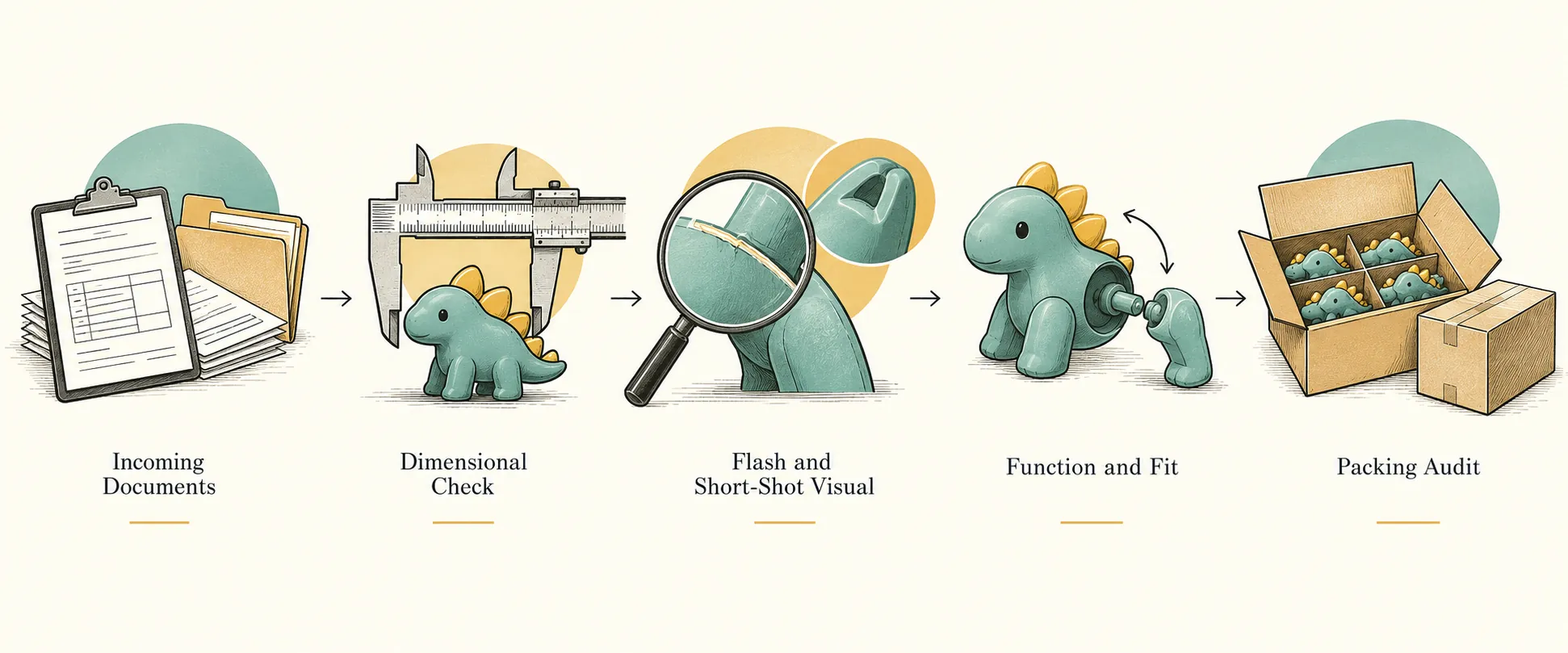
Inspection work for filled TPR and slow-rise PU splits along different failure modes, so the two should never share one checklist. Filled TPR is a shell-plus-fill construction: you inspect the shell for wall thickness and transparency, the fill for quantity and containment, and the seam for bond integrity. Slow-rise PU is a foam construction: you inspect cell structure, skin finish, and recovery behavior. The practical decision: build two separate inspection plans, each with its own record, failure signal, and release rule, and treat hand checks as screening only — not as safety certification or an age determination.
Which Inspection Dimension Applies to Which Construction?
| Shell / outer surface | Filled TPR: check wall thickness consistency, transparency, glitter dispersion, and mold-copy fidelity against the approved reference. Slow-rise PU: check skin for blowholes, clouding, or uneven matte finish. Failure signal (TPR): thin or cloudy patches, visible flow lines. Failure signal (PU): surface pits or collapsed skin. |
|---|---|
| Fill / core | Filled TPR: verify fill quantity and containment by weight comparison and by feel through the shell; watch for underfill (slack shell) or overfill (stressed seam). Slow-rise PU: internal structure is porous and heterogeneous, with cells distributed through the foam; check for large voids, hard spots, or density variation across the batch. Failure signal: inconsistent fill weight between units, or a PU core that feels dense in one area and hollow in another. |
| Seam / bond line | Filled TPR: inspect the seal line for complete fusion, flash, and gaps; a seam is the highest-risk zone because it holds the fill. Slow-rise PU: there is typically no fill seam — inspect mold parting lines instead. Failure signal (TPR): a seam that opens under light flex or shows a visible gap. Failure signal (PU): a parting line with flash or a tear initiation point. |
| Recovery / compression behavior | Filled TPR: press and release — the shell should return without permanent denting; the fill should not migrate. Slow-rise PU: press and release — the foam should recover slowly and evenly; the cell structure determines the feel. Failure signal: a TPR shell that stays dented, or a PU foam that recovers unevenly or stays compressed. |
| Weight | Filled TPR: unit weight is driven by shell plus fill; compare unit-to-unit, not carton-to-unit. Slow-rise PU: unit weight is driven by foam density; a lighter unit may indicate under-foaming. Failure signal: weight drift within a batch. Do not infer unit weight from carton mass. |
| Evidence boundary | All of the above are visual, tactile, and dimensional observations. They screen for consistency and workmanship. They do not certify safety, determine an age grade, or substitute for laboratory testing against the applicable toy safety rules for the actual configuration. |
What Should the Filled TPR Inspection Sequence Look Like?
Start with the approved reference, not the carton. Before bulk release, the approved reference is the unit you signed off against the agreed specification — including shell material, fill type, and seam construction. If a side-by-side photograph is missing, that alone does not invalidate the inspection; the physical reference and the signed spec still govern. What matters is that you are comparing production units to a fixed, agreed baseline rather than to memory.
Step 1 — Shell. Input: the approved reference and the production unit. Action: hold both to light, compare transparency, glitter dispersion, and wall thickness at the same points. Record: a pass/fail note per unit and a photo of any deviation. Failure signal: cloudy patches, thin walls, or flow lines absent from the reference. Next decision: if the shell deviates, quarantine the batch and request a corrected sample before proceeding.
Step 2 — Fill. Input: the approved fill weight and the production unit. Action: weigh a defined sample of units and compare the spread; feel the shell for slack or stress. Record: the measured weights and the spread. Failure signal: a spread wider than your own buyer-defined limit, or a shell that feels slack (underfill) or tight and stressed (overfill). Next decision: if the spread exceeds your limit, ask the supplier to adjust the fill process and re-submit for recheck.
Step 3 — Seam. Input: the approved seam construction. Action: flex the unit lightly at the seam and inspect the bond line under good light. Record: a pass/fail per unit and a photo of any open or gapped seam. Failure signal: a seam that opens, shows a gap, or has flash that could catch. Next decision: any open seam is a hold — do not release until the seam is corrected and rechecked.
Step 4 — Recovery. Input: the approved reference. Action: press the unit, hold, release, and compare the return to the reference. Record: a pass/fail note. Failure signal: a permanent dent, or fill that migrates within the shell. Next decision: if recovery deviates, treat it as a construction issue and escalate to the supplier before release.
What Should the Slow-Rise PU Inspection Sequence Look Like?
Slow-rise PU inspection is a foam inspection, so the sequence changes. There is no fill seam to check; the core is the product. The approved reference still governs, but the observations are about cell structure, skin, and recovery rather than shell and fill.
Step 1 — Skin and surface. Input: the approved reference. Action: inspect the skin for blowholes, clouding, uneven matte finish, and mold parting lines. Record: a pass/fail note per unit and a photo of any surface defect. Failure signal: pits, collapsed skin, or flash at the parting line. Next decision: surface defects that affect appearance or create a tear initiation point are a hold for correction.
Step 2 — Cell structure and density. Input: the approved reference and, where available, a cut section from a scrap unit. Action: compare the cell distribution and look for large voids, hard spots, or density variation. Record: a note on cell uniformity and any void locations. Failure signal: large voids or hard spots that differ from the reference. Next decision: if the core is inconsistent, request a process correction and recheck before release.
Step 3 — Recovery. Input: the approved reference. Action: press, hold, release, and time the return by feel against the reference. Record: a pass/fail note. Failure signal: uneven recovery, a foam that stays compressed, or a recovery that is noticeably faster or slower than the reference. Next decision: recovery deviation is a construction signal — escalate before release.
Step 4 — Weight. Input: the approved unit weight range. Action: weigh a defined sample and compare the spread. Record: the measured weights and the spread. Failure signal: a spread wider than your own buyer-defined limit, or a batch that is uniformly lighter than the reference (possible under-foaming). Next decision: if the spread or the mean deviates, request a process correction and recheck.
How Do You Record, Correct, and Recheck Findings Before Release?
Every inspection step produces a record. The record should name the unit, the observation, the comparison point (approved reference or spec clause), and the pass/fail result. A photo is useful but not mandatory for every unit; a missing side-by-side photo does not by itself invalidate an inspection, provided the physical reference and the signed spec are available.
When a failure signal appears, the next decision is one of three: hold, correct, or release. A hold means the batch does not ship until the issue is resolved. A correction means the supplier adjusts the process or the unit and re-submits for recheck. A release means the batch meets the agreed criteria and the record is signed off. The recheck uses the same input, action, and record as the original step, so the comparison is like-for-like.
Keep the inspection stage as production or pre-shipment release. First-sample approval is a separate gate: before approval, you compare the sample to the agreed specification and create the approved reference. After approval, the bulk inspection compares production to that reference. Do not merge the two — a bulk inspection is not a re-approval of the sample.
Visual inspection, functional screening, sampling, and laboratory testing have different purposes. Visual and tactile checks screen for consistency and workmanship. Functional screening checks that the unit works as intended. Sampling defines how many units you check. Laboratory testing is the only route to a safety conclusion against the applicable toy safety rules for the actual configuration. A hand check does not certify safety, determine an age grade, or predict return rates.
What Are the Evidence Boundaries for Each Construction?
Filled TPR and slow-rise PU are different material systems, and the inspection evidence you can gather by hand differs accordingly. For filled TPR, the observable evidence is shell appearance, fill weight and containment, seam integrity, and recovery. For slow-rise PU, the observable evidence is skin finish, cell structure, density variation, recovery, and weight. In both cases, the observation is a screening result, not a compliance result.
The internal structure difference is well documented for TPR: unfoamed TPR has a dense, homogeneous, pore-free internal structure, while foamed TPR has a porous, heterogeneous structure filled with cells Lien Industrial. Typical density of unfoamed TPR is about 0.9–1.0 g/cm³, while foamed TPR can be as low as 0.3–0.6 g/cm³ Lien Industrial. These ranges describe material behavior, not acceptance limits; do not treat them as mandatory tolerances or as a quality ranking.
For slow-rise PU, the inspection is about the foam itself. There is no shell-and-fill split, so the seam check does not apply. The recovery observation is the closest analogue to the TPR fill check, but it measures the foam's cell behavior rather than fill quantity. Do not transfer a TPR checklist onto a PU unit or vice versa.
One practical consequence: a carton quantity is not an order multiple, and a carton mass is not a unit mass. When you weigh units for fill or density screening, weigh individual units, not cartons. When you set a sample size, define it in your own inspection plan; do not assume a carton count implies a sampling rule.
Where Does Laboratory Testing Fit?
Laboratory testing is separate from the inspection sequence above. The applicable toy safety rules depend on the destination market and the actual toy configuration, and laboratory acceptance is specific to the relevant safety rules — one laboratory may not cover every required test. Match the applicable requirements and the laboratory's scope to the actual configuration before you rely on a report.
For the EU market, use the current European Commission toy safety page and the cited legal text to identify the applicable rules, and distinguish rules already applicable from rules adopted but not yet in force European Commission. For the US market, the CPSC explains that laboratory acceptance is specific to the relevant safety rules and that one laboratory may not cover every required test CPSC. These are document-review principles, not claims that any specific model has been tested or certified.
Do not invent a pliers or pull test as a compliance test. A hand flex or press is a screening action; a safety conclusion requires the specified laboratory test for the applicable rule. Keep the two separate in your records so a screening pass is never mistaken for a compliance result.
Frequently Asked Questions
Can one inspection checklist cover both filled TPR and slow-rise PU?
No. Filled TPR inspection centers on shell, fill, and seam; slow-rise PU inspection centers on skin, cell structure, and recovery. Build two plans with separate records and failure signals. A shared checklist will miss the failure mode that matters for each construction.
Does a missing side-by-side photograph invalidate the inspection?
No. A missing side-by-side photograph alone does not invalidate an inspection. The approved physical reference and the signed specification govern the comparison. Photographs are useful supporting records, not the baseline.
Can a hand press or flex test certify safety?
No. A hand press, flex, or weight check is a screening action for consistency and workmanship. It does not certify safety, determine an age grade, or predict return rates. A safety conclusion requires the specified laboratory test against the applicable toy safety rules for the actual configuration.
How should fill or density screening be recorded?
Record the unit identifier, the measured value, the comparison point (approved reference or spec clause), and the pass/fail result against your own buyer-defined limit. Weigh individual units, not cartons. If the spread or mean deviates, request a process correction and recheck before release.
What is the difference between first-sample approval and bulk inspection?
First-sample approval compares the sample to the agreed specification and creates the approved reference. Bulk inspection compares production units to that approved reference at the production or pre-shipment stage. They are separate gates with separate records.
Does a carton quantity define the order multiple?
No. A carton quantity is a packing figure, not an order multiple. Unless the supplier explicitly states a full-carton order restriction, do not assume you must round every order up to a full carton or pay for surplus units.
Sources
Need an Inspection Plan for Your Actual Configuration?
If you are sourcing filled TPR or slow-rise PU toys and need a documented inspection plan — shell, fill, seam, foam, finish, and recovery checks with defined records and release rules — our team can help you build one against your approved reference and your destination market. We support ordinary sampling, standard customization, packaging coordination, and procurement quality checks at established industry level. Contact us with your product configuration and target market to scope the inspection work.
Put this into your procurement file.
Send the model, destination and approval scope to our team.
Request Audit Documents