2026-10-16
An EXW price is the seller's minimum obligation: the goods are made available at the factory or warehouse, and the buyer carries every cost and risk from that point to the destination. So when a squishy toy is quoted at US$0.65–0.68 per piece EXW, that number is a starting input, not a landed cost. Build the full sheet — pickup, export clearance, freight, destination charges, receiving — before you compare suppliers, because the cheapest unit price often loses once carton configuration and order quantity are applied.
This worksheet is for retail-chain buyers and compliance-led sourcing managers who need a defensible cost per sellable unit. Every freight, duty and receiving figure below is explicitly hypothetical arithmetic for method demonstration. It is not a current quote, and it is not a tariff or freight-rate claim.
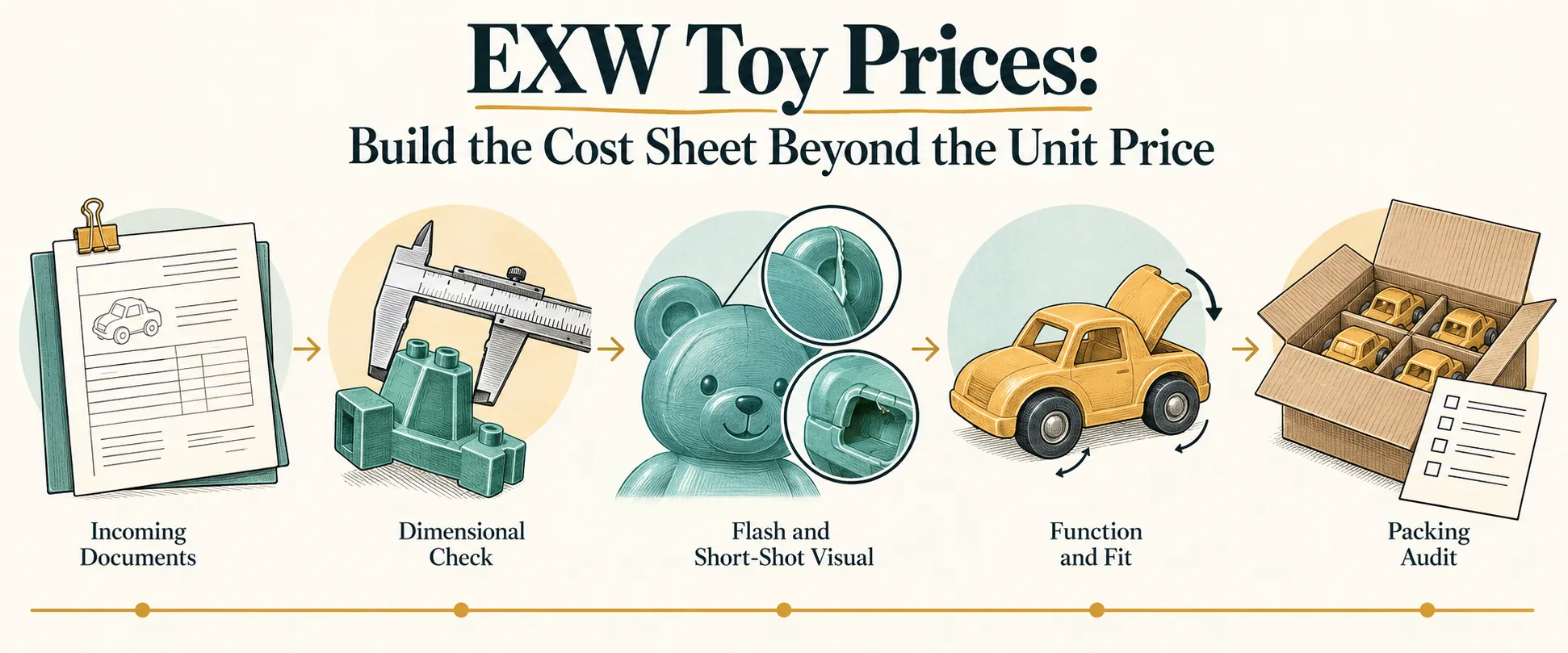
What does EXW actually include, and what does it exclude?
Under EXW (Ex Works), the seller fulfills delivery when the goods are placed at the buyer's disposal at the named place, not loaded onto the buyer's collecting vehicle and not cleared for export unless the contract says otherwise. The buyer bears all cost and risk of moving the goods from the seller's premises to the destination. That makes EXW the term with the lowest seller responsibility.
Practically, an EXW quotation should be read as covering raw material, labor, packaging and the seller's margin — and nothing downstream. The buyer's sheet must add: inland pickup and loading at origin, export customs formalities and any export documentation, origin port charges, main freight, destination port or airport charges, import clearance and duties, final-mile delivery, and receiving at your warehouse. If your supplier can also quote FOB Shantou, Yantian or Shenzhen, or CIF and door-to-door arrangements, those alternatives shift specific line items back to the seller — compare the same scope, not just the headline number.
One caution that costs real money: EXW does not automatically mean the seller handles Chinese export clearance. If your forwarder cannot act as the exporter of record, confirm in writing who files the export declaration and who holds the export license before you book anything.
Build the cost sheet: line items, owner and timing
A cost sheet that only sums numbers will fail at the first change order. Add two columns: who pays, and when the cost is triggered. That is how you catch charges that appear after the PO is signed — origin handling, documentation, destination demurrage risk, and receiving labor.
Use hypothetical per-shipment values to test sensitivity, then replace them with your own forwarder's numbers. The structure matters more than the placeholder values.
Two structural traps deserve a line of their own. First, carton mass is not unit mass: a 72-piece carton tells you nothing about the finished weight of one squishy toy, so never derive unit weight from carton data. Second, a carton quantity is not automatically an order multiple — unless the supplier states a full-carton restriction, do not assume you must round every order up to whole cartons.
Hypothetical EXW vs FOB vs CIF cost allocation
| Inland pickup and loading at factory — EXW | Buyer |
|---|---|
| Inland pickup and loading at factory — FOB | Seller |
| Inland pickup and loading at factory — CIF | Seller |
| Export customs clearance — EXW | Buyer (confirm in writing) |
| Export customs clearance — FOB | Seller |
| Export customs clearance — CIF | Seller |
| Origin port charges — EXW | Buyer |
| Origin port charges — FOB | Seller |
| Origin port charges — CIF | Seller |
| Main freight — EXW | Buyer |
| Main freight — FOB | Buyer |
| Main freight — CIF | Seller |
| Cargo insurance — EXW | Buyer |
| Cargo insurance — FOB | Buyer |
| Cargo insurance — CIF | Seller (minimum cover) |
| Import duty and clearance — EXW | Buyer |
| Import duty and clearance — FOB | Buyer |
| Import duty and clearance — CIF | Buyer |
| Final-mile delivery and receiving — EXW | Buyer |
| Final-mile delivery and receiving — FOB | Buyer |
| Final-mile delivery and receiving — CIF | Buyer |
| Destination terminal and unloading charges — quotation check | Ask the forwarder for a line-by-line breakdown: included in the quoted freight, payable separately, and the named paying party. Reconcile it with the signed sale and carriage terms before adding costs to the sheet. |
Worked example: three catalog models, three different cost profiles
The three SKUs below are drawn from current catalog records. Unit prices and MOQs are observed catalog facts; all downstream costs are hypothetical placeholders used only to show how the sheet behaves.
Model A — Glitter-Fill Smiling Bun Squishy: US$0.65–0.68 per piece EXW, MOQ 5 cartons / 360 pcs, 72 pcs per carton, display box. Model B — Dough-Fill Smiling Bun Squishy: US$0.62–0.65 per piece EXW, MOQ 5 cartons / 360 pcs, 72 pcs per carton, display box. Model C — Gradient Bun Squishy with Steamer: US$0.67 per piece EXW, PU foam, MOQ 3 cartons / 864 pcs, 288 pcs per carton, display box.
For Models A and B only, apply a hypothetical US$150 origin pickup/export allowance per shipment and US$0.01 receiving cost per piece. US$150 divided by 360 pieces is about US$0.42 per piece; divided by 3,600 pieces it is about US$0.04. Comparing the catalog lower price endpoints, US$0.65 minus US$0.62 is US$0.03 per piece; the quoted price ranges also overlap. Model C has a different MOQ: 3 cartons / 864 pieces at 288 pieces per carton, while Models A and B record 5 cartons / 360 pieces at 72 per carton. Do not apply the 360-piece order example to Model C.
In the same hypothetical Models A/B exercise, main freight of US$2,000 per shipment adds about US$5.56 per piece at 360 pieces or US$0.56 at 3,600 pieces. The US$150 origin allowance excludes main freight; the US$2,000 freight allowance excludes origin pickup/export. At 360 pieces these separate allowances total US$2,150 / 360, or about US$5.97 per piece. Adding the observed A/B product prices and the hypothetical US$0.01 receiving allowance yields approximately US$6.60–6.66 per piece. This deliberately costly sensitivity example demonstrates fixed-cost exposure; it is not a feasible freight quote or forecast. Add other applicable charges separately.
Where compliance and packaging costs enter the sheet
Suggested buyer task: request the existing report scope for the selected SKU and destination market. Review whether it covers the ordered configuration with your compliance team or testing provider. Assess any additional testing against the applicable market requirements before entering an allowance in the cost sheet.
Include separate cost-sheet lines for any quoted tooling, artwork, packaging setup and additional testing. Fill them from the approved project scope and quotation; do not assume every packaging or color change requires a new test.
Procurement worksheet: columns to build
| Unit price (observed) | From quotation, per piece, EXW |
|---|---|
| Order quantity (buyer input) | Your planned volume |
| Carton quantity (observed) | Pieces per carton from catalog or quotation |
| Carton count (calculated) | Order quantity ÷ carton quantity |
| MOQ (observed) | Minimum order quantity from quotation |
| Inland pickup and loading (hypothetical) | Per shipment |
| Export clearance and documentation (hypothetical) | Per shipment |
| Origin port charges (hypothetical) | Per shipment |
| Main freight (hypothetical) | Per shipment |
| Cargo insurance (hypothetical) | Percentage of CIF value |
| Destination port charges (hypothetical) | Per shipment |
| Import duty and clearance (hypothetical) | Per shipment |
| Final-mile delivery (hypothetical) | Per shipment |
| Receiving and put-away (hypothetical) | Per piece |
| Compliance and re-test allowance (hypothetical) | Per project |
| Packaging and artwork setup (hypothetical) | Per project, first order |
| Landed cost per piece (calculated) | Total cost ÷ order quantity |
Buyer questions on EXW cost sheets
Does an EXW price include export clearance?
No, not by default. Under EXW the seller need not clear the goods for export unless the contract says so. Confirm in writing who files the export declaration and who holds the export license before booking.
Can I compare an EXW quote directly with a FOB quote?
Not line by line. FOB shifts origin inland, export clearance and origin port charges to the seller. To compare fairly, add those items to the EXW quote or subtract them from the FOB quote so both cover the same scope.
How do I convert a carton quantity into an order multiple?
You do not, unless the supplier states a full-carton restriction. A carton quantity tells you how the goods pack, not how you must order. Check the quotation for an explicit order multiple before rounding up.
Should I use carton weight to estimate unit weight?
No. Carton mass includes packaging and multiple pieces. If unit weight matters for freight or compliance, request a finished-unit measurement rather than deriving it from the carton.
At what order volume do fixed shipment costs stop dominating?
There is no universal threshold. Divide your total fixed shipment cost by the order quantity to get the per-piece impact, then compare that against the unit price gap between suppliers. The break-even point is where the price advantage exceeds the fixed-cost penalty.
Do custom colors or packaging affect compliance costs?
Request a written scope review for the proposed color or packaging change. Whether additional testing is needed depends on the actual change and applicable requirements; obtain the assessment before budgeting a specific test charge.
Get the audit and tooling checklist before you sign the PO
Before you commit to an EXW order, request the SKU-matched test documents for the exact configuration you are buying, and confirm the export-clearance responsibility in writing. If your project involves custom colors, packaging or tooling, ask for a written scope review that maps each change to its test impact. A written review helps identify testing scope and cost responsibility before signing, reducing the risk of an unbudgeted configuration change. Request the selected SKU report scope.
Catalog reference
Put this into your procurement file.
Send the model, destination and approval scope to our team.
Request Audit Documents