2026-10-30
Approve an electronic pop game against a model-specific compliance file, not a certificate offered for an entire powered-toy catalog. The purchase decision should connect the destination market, exact configuration, mechanical toy assessment, battery construction, electrical functions and final labeling. Keep catalog observations separate from proposed checks, then release the order only after the compliance reviewer accepts the relevant evidence and closes the conditions for that configuration. A familiar housing or matching product name is not enough to establish report coverage.
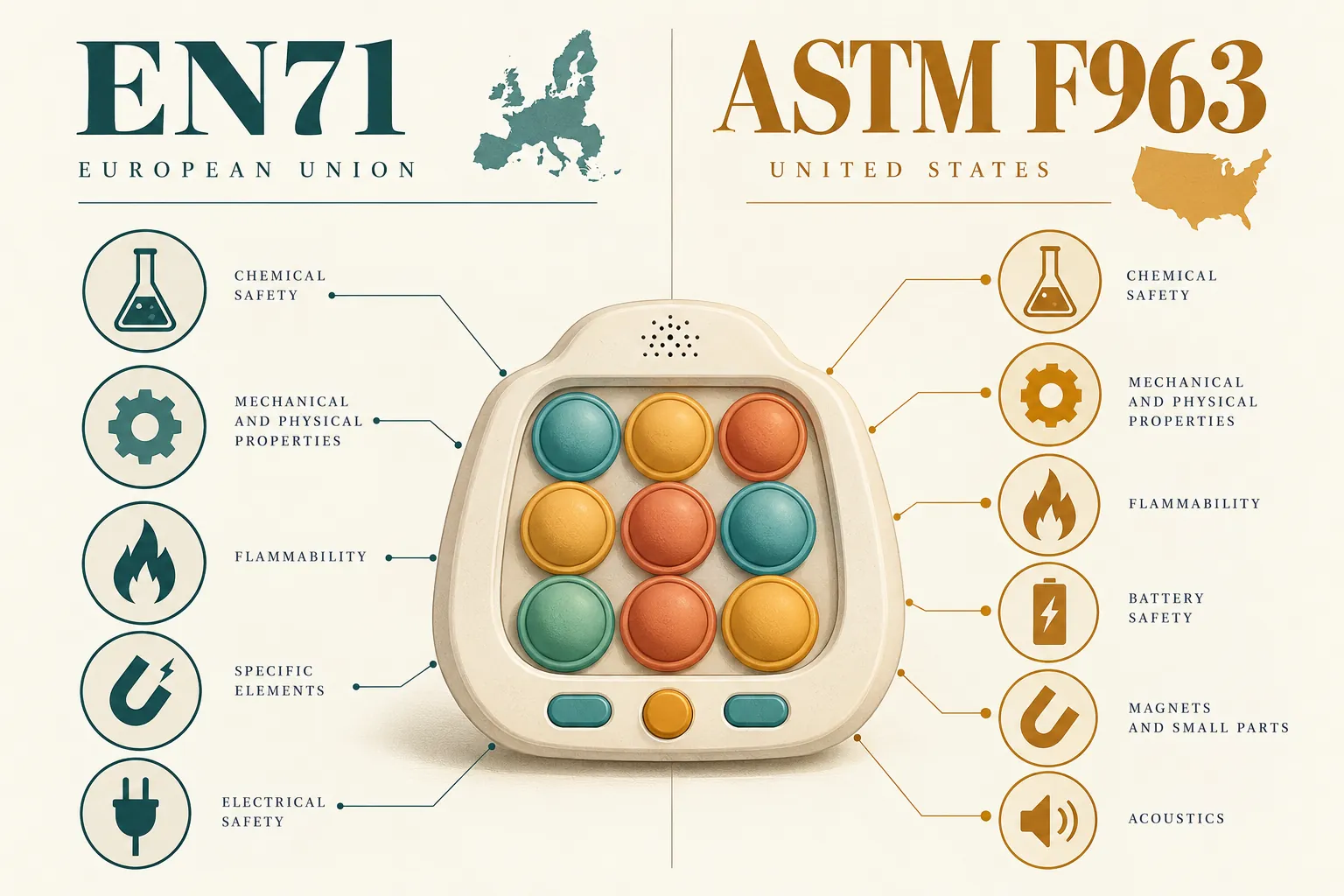
What changes in the file when a pop game is powered?
Power adds battery and electrical questions that a mechanical-only assessment does not answer. A report may cover several scopes, but the buyer must check its actual contents rather than infer coverage from the title or certificate cover page.
Keep four review lanes visible. Mechanical review addresses the accessible construction and moving parts. Battery review identifies the cells, compartment and access controls. Electrical review connects the circuit and powered functions to the assessed configuration. Labeling review checks the finished product, packaging and instructions against the destination-market assessment.
These lanes organize purchasing review; they are not an exhaustive test specification. Connect applicable material, chemical and flammability evidence to the same model record rather than treating the mechanical column as the whole toy-safety file.
| Mechanical toy scope | Proposed checks: accessible small parts, edges and points; attachment security; pinch or entrapment locations; and the construction of any moving reset mechanism. Request the relevant report sections and sample-identification photographs. |
|---|---|
| Battery scope | Proposed checks: cell chemistry, format, quantity and voltage; supplied versus separately purchased cells; compartment design and fasteners; polarity; and access after the applicable assessment. Add button/coin-cell or rechargeable-battery review only when the actual configuration warrants it. |
| Electrical scope | Proposed checks: circuit and component identification, light and sound functions, heating and fault-condition assessment, and charging or external-power arrangements if fitted. Ask the reviewer to determine EMC or radio scope from the actual electronics. |
| Labeling scope | Proposed checks: model identification, intended age and its rationale, market-specific warnings, battery instructions, traceability information, language versions and applicable markings. Review controlled artwork, not just a photograph of a generic box. |
What do the two catalog records actually establish?
The two records establish product identity, a light-up product description, catalog material labels and color-box packaging—not a battery configuration or a test conclusion.
Use the linked product pages as identity anchors: the Crab-Shape Light-Up Push Game and the Light-Up Bubble Push Game, Model 273258. Preserve the catalog material wording, but request component-level construction details before matching either product to a report.
| Crab-Shape Light-Up Push Game — STS290030 | Observed catalog fields: Name: Crab-Shape Light-Up Push Game; Material: Plastic; Packaging: Color box. Proposed checks: identify the battery arrangement, circuit, accessible materials, compartment construction, finished sample and controlled packaging revision. |
|---|---|
| Light-Up Bubble Push Game, Model 273258 — STS273258 | Observed catalog fields: Name: Light-Up Bubble Push Game, Model 273258; Material: ABS; Packaging: Color box. Proposed checks: identify the battery arrangement, circuit, accessible materials, compartment construction, finished sample and controlled packaging revision. |
| Comparison consequence | Plastic and ABS are catalog material descriptions, not proof of identical or different internal electronics. Similar light-up functions and the same packaging format do not establish shared report coverage. Request a documented construction comparison before accepting one report for both models. |
How should the destination market change the document request?
Create separate US and EU review entries because an approval for one destination should not silently become approval for another. Treat the requests below as purchasing controls; the compliance lead must identify the applicable legal route for the actual product and intended market-entry date.
For the EU entry, use the European Commission toy-safety guidance and the legal texts it links to when identifying the applicable framework. Record applicable rules separately from adopted changes that are not yet applicable; do not substitute a vendor's general “EN71” statement for that assessment.
| United States review entry | Request a written applicability assessment identifying the intended age, relevant toy and powered-product provisions, supporting test evidence, certification route and label content. Require the reviewer to distinguish toy battery provisions from any separate battery or electronics provisions that apply to the actual configuration. |
|---|---|
| European Union review entry | Request the applicable toy-safety assessment, technical documentation, declaration and marking review for the identified model. Have the reviewer separately resolve electrical safety, EMC, battery and other electronics-related scope where relevant; do not assume that an EN 71 report answers every powered-product question. |
| Other destination markets | Add a separate market entry and local applicability assessment before extending approval. Reuse construction evidence only where its scope remains relevant; do not relabel an existing market approval. |
What should the market-and-model document matrix contain?
Use one row per model and destination market, tied to a controlled configuration revision. The worked matrix below records catalog observations and proposed review actions; it does not assign a passing or failing test result to either product.
“Observed—catalog” means a field appears in the identified catalog record retained on file; it is not compliance evidence. Mark a scope cell “Observed—document reviewed” only when the actual supporting document is on file and the reviewer has checked its coverage, sample identity and configuration revision, then recorded the relevant result and document reference. Otherwise, keep that scope review “Proposed” with an open condition. A proposed check is an action to complete, not evidence of conformity.
| STS290030 — United States | Configuration: catalog Plastic; light-up product description; color box. Mechanical scope: request model-matched construction and test assessment. Battery scope: identify cells, compartment and access controls before setting the review scope. Electrical scope: match circuit and powered functions to the assessment. Labeling scope: review US product, box and instruction artwork. Document reference: enter the catalog capture revision plus the actual applicability memo, report sections, photographs and artwork revision reviewed. Status: Observed—catalog fields; Proposed—scope reviews. Open conditions: approve the configuration revision and close each applicable US review item before purchase release. |
|---|---|
| STS290030 — European Union | Configuration: catalog Plastic; light-up product description; color box. Mechanical scope: match construction to the EU toy-safety assessment. Battery scope: establish the cell and compartment configuration. Electrical scope: assess powered functions and determine relevant electronics-related scope. Labeling scope: review destination-language artwork, instructions and applicable markings. Document reference: enter the actual technical-file index, declaration, supporting reports and artwork revisions reviewed. Status: Observed—catalog fields; Proposed—scope reviews. Open conditions: establish applicable rules for the intended market-entry date and obtain compliance sign-off for this revision. |
| STS273258 — United States | Configuration: catalog ABS; light-up product description; color box. Mechanical scope: match the accessible construction and moving parts to the assessment. Battery scope: identify cells and compartment construction without borrowing assumptions from the crab-shaped model. Electrical scope: verify the circuit and powered functions covered by the evidence. Labeling scope: review US artwork and instructions for this model. Document reference: enter the actual applicability memo, supporting reports, sample photographs and artwork revision reviewed. Status: Observed—catalog fields; Proposed—scope reviews. Open conditions: close model matching and applicable US document checks before purchase release. |
| STS273258 — European Union | Configuration: catalog ABS; light-up product description; color box. Mechanical scope: connect the model to its EU toy-safety assessment. Battery scope: establish cell details, access controls and relevant assessment. Electrical scope: document the circuit review and applicability decisions for electronics-related requirements. Labeling scope: review destination-language artwork, instructions and applicable markings. Document reference: enter the actual technical-file index, declaration, supporting reports and artwork revisions reviewed. Status: Observed—catalog fields; Proposed—scope reviews. Open conditions: obtain a configuration-specific EU decision; use shared reports only with documented coverage. |
How should the buyer decide approve, hold or reject?
Approve only the exact market, model and configuration whose applicable review items have been accepted and whose release-blocking conditions are closed. A populated document-reference cell is not enough: the reviewer must assess relevance, coverage and conclusions.
Hold when a consequential configuration detail, scope decision or document review remains unresolved. Reject the submitted configuration when the review establishes an unacceptable result or the supplier cannot meet an agreed release condition. Missing paperwork alone does not prove that a toy is unsafe, and a report on file does not prove that every production unit conforms.
| Identity and revision | Record the model identifier, destination market, intended age, approved specification revision, sample identifier, battery arrangement, circuit revision and packaging/instruction revisions. |
|---|---|
| Specified target versus observation | Keep the applicable requirement or agreed purchasing target in a separate field from the observed construction, reported result or artwork finding. Record any deviation explicitly rather than replacing the target with the observed value. |
| Decision and responsible approval | Record Approve, Hold or Reject; the decision's scope and conditions; the procurement owner; the responsible compliance approver; and the actual decision date. |
| Follow-up closure | Assign each open condition an owner and agreed due date. Close it with the corrective revision or supporting document reference, reviewer acceptance and closure date. Preserve the earlier decision and its supporting record. |
Which changes should reopen the review?
Reopen the affected matrix cells when the approved construction or labeling changes; do not automatically demand a new full test program for every internal identifier or production batch.
A different cell format, battery supplier, compartment door, fastener, circuit board, light module, accessible material or charging arrangement calls for a documented impact review. Packaging and instruction changes reopen labeling review and may affect the age or use assumptions underlying other assessments. Let the reviewer determine whether existing evidence still covers the revised construction and which additional checks are necessary.
A controlled record supports traceability, but it cannot by itself reveal an undisclosed substitution. Compare the purchase specification and approved sample with production inspection observations, and require supplier notification before changing controlled components.
For the next Crab-Shape Light-Up Push Game — STS290030 review, request a model-matched test-document scope review covering the battery specification, compartment photographs, circuit identification, complete report scope, US/EU applicability decisions and final artwork revision. Identify the proposed configuration revision in the request and ask for a returned matrix showing accepted document references, open conditions and the responsible reviewer before purchase release. The product page anchors catalog identity; it does not establish report coverage or approval.
Put this into your procurement file.
Send the model, destination and approval scope to our team.
Request Audit Documents