2026-11-03
Retain the Rainbow Bead Rotation Ball’s recorded 22 kg carton net weight, 23.5 kg carton gross weight, and 240 pieces per carton as carton-level data—not finished-unit mass. Flag any unit-weight entry derived from those figures for correction, and request a measured finished-unit mass tied to the approved configuration. Dividing either carton weight by 240 produces an allocation per piece; it does not establish a measured product weight for listings, unit-based estimates, or documents.
The buying decision is field-specific: retain the catalog’s carton data as a planning reference, but do not approve an inferred unit weight. Final shipping-carton measurements still need reconciliation with the approved packing specification and packing list.
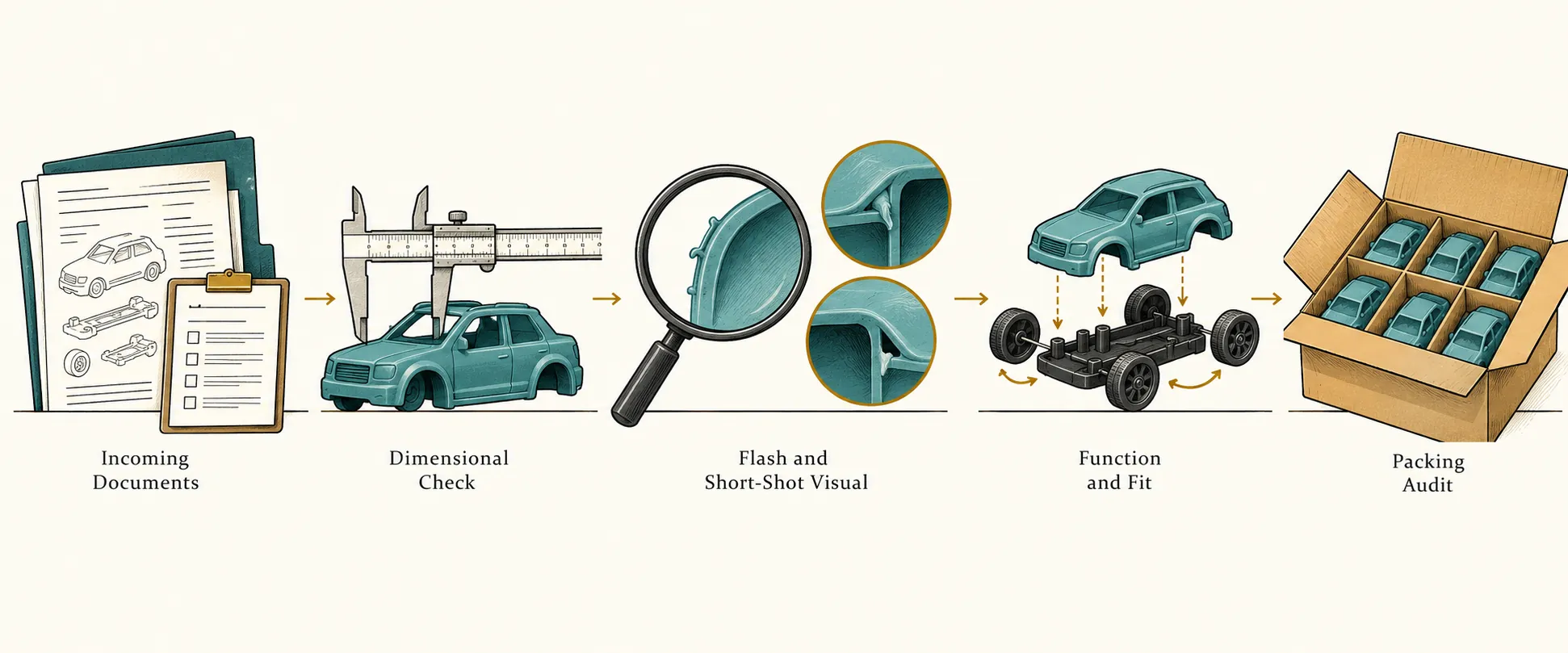
What does the Rainbow Bead Rotation Ball catalog record establish?
| Catalog identity | STS342716 — Rainbow Bead Rotation Ball |
|---|---|
| Packaging | Color box |
| Carton quantity | 240 pcs/carton |
| Carton N.W. | 22 kg — recorded carton net weight, not an individual finished-unit measurement |
| Carton G.W. | 23.5 kg — recorded carton gross weight, not an individual finished-unit measurement |
Why does dividing carton mass by 240 not prove unit mass?
Dividing carton mass by the recorded piece count produces an average allocation, not a directly measured finished-unit mass. Even with a confirmed count, the result depends on exactly what the weighing basis includes.
The N.W. label alone does not establish whether retail boxes, inserts, or other packing components were excluded. G.W. includes the shipping pack rather than the bare product alone. Neither division documents individual variation or independently confirms that the carton contains 240 saleable pieces.
For this record, require a direct measurement before publishing finished-unit mass. If a measured sample average is later approved, identify it as an average and retain the individual readings and sample basis. Keep bare-product mass, retail-packed unit mass, and shipping-carton mass in separate fields.
How should buyers inspect the closed shipping carton?
Inspect the final sealed carton against the approved packing revision, then reconcile the observations with the final packing list. Before the purchase order, treat catalog weights and proposed dimensions as planning data; do not describe them as final packed measurements.
Dimensions and units: measure the external length, width, and height of the closed carton, including bulges, and record the measurement units explicitly. Compare them with the approved packing specification. A difference is a review signal, not an automatic shipment failure: apply buyer-agreed tolerances, check its effect on volume and handling, and approve the variance or require repacking and remeasurement.
Count: compare the carton’s quantity marking with the approved pack configuration, pack-out count record, and packing list. For this configuration, the catalog reference is 240 pieces per carton. Conflicting counts require reconciliation or separately authorized count verification before count approval; weighing a sealed carton does not prove its contents.
Weights: weigh the sealed carton for actual G.W. and compare the result with the approved target and packing list. Support N.W. with a pack-out weighing record that identifies included and excluded packaging. A sealed-carton reading must not be relabeled as net weight. Resolve unexplained differences by checking the scale, units, count, and packing revision before correcting documents or accepting a variance.
Strength and condition: compare the carton specification and any required strength-test report with the approved packaging requirements. Inspect for crushed panels, split seams, wet board, and failed closures. Damage calls for packaging review and possible repacking; a clean appearance does not prove compression strength. Where strength performance is specified, use the agreed test method and acceptance criteria rather than a hand squeeze.
Shipping marks: compare the printed marks with approved artwork and the packing list, including item identity, order reference, carton sequence, quantity, and any stated weights and units. Wrong identities, mixed unit bases, or unreadable labels require correction and reinspection before packing approval. Keep destination-specific paperwork in its own document review.
How should carton CBM be calculated and reconciled?
Calculate carton CBM from external packed dimensions, then multiply by the number of cartons in that same configuration.
Explicitly hypothetical example—not this product’s recorded dimensions or shipment: a closed carton measures 50 cm × 40 cm × 30 cm. Using L(cm) × W(cm) × H(cm) / 1,000,000 gives 0.06 m³ per carton. For a hypothetical 100 identical cartons, total carton volume is 0.06 × 100 = 6 m³.
Compare the calculation with the final packing list. If carton sizes differ, calculate each configuration separately and add the totals. Investigate unit errors, transposed dimensions, or an outdated packing revision before accepting a discrepancy. CBM is a volume calculation; it does not establish unit mass or carton strength.
How should the unit-weight field be corrected?
Correct the unit-weight field by removing any carton-derived value and replacing it only with approved, configuration-specific measurement evidence.
Open the current record and preserve its previous revision. Retain 22 kg under carton N.W., 23.5 kg under carton G.W., and 240 pieces under carton quantity. In the internal correction record, mark an inferred unit-weight value as unsupported and identify any listings, calculation sheets, or documents that reused it.
Request a measured finished-unit mass with the exact model and configuration, a clear statement of included components, scale identification and resolution, weighing method, sample quantity, individual readings, measurement date, and responsible measurer. Ask separately for retail-packed unit mass if that is the field the receiving system requires.
When a measurement arrives, compare its identity and measurement basis with the approved product configuration before updating the field. Record the source, date, and catalog revision. If the field previously fed another document or listing, check that downstream copy rather than assuming the catalog correction reached it.
Can the same field-basis check be reused across catalog records?
Reuse the field-basis check across products, but never transfer a weight or pack configuration from one product to another.
The Linked Dancing Squid Toy also records 240 pieces per carton, while the Crystal Gyro Ball in Retail Display records 288. Matching carton counts do not establish matching unit weights, and a different count requires its own packing reference. For both records, request direct unit-mass evidence before populating a finished-unit weight field.
Who approves exceptions and closes the correction?
The buyer or sourcing manager should approve the catalog correction, with the compliance lead reviewing any intended use in compliance documents. Approval should distinguish a supported unit-mass value from a decision to leave that field unpopulated.
Keep one handoff record containing the product identity and configuration, catalog and packing revisions, specified target versus observed value, evidence reference, discrepancy, decision and conditions, responsible approver and approval date, follow-up owner, and closure evidence and date.
If no direct measurement is available, leave the published unit-weight field blank and retain an internal unsupported status; do not substitute carton division. If a receiving system requires that value, pause that field-dependent submission. If two measurements conflict, compare their packaging basis, configuration, units, method, and sample records before selecting or repeating a measurement—not simply the more convenient number.
Close the exception when the field is supported and approved, or when its omission is explicitly approved and affected downstream uses are resolved. This record supports traceability; it cannot by itself reveal an undisclosed packing change. Product-safety testing remains a separate release check, and carton approval does not replace it.
Request a carton-to-unit field-basis audit report covering the catalog revision, approved packing specification, final packing list, sealed-carton measurements, and direct unit-mass record, with each correction assigned an owner and closure condition.
Put this into your procurement file.
Send the model, destination and approval scope to our team.
Request Audit Documents