2026-10-16
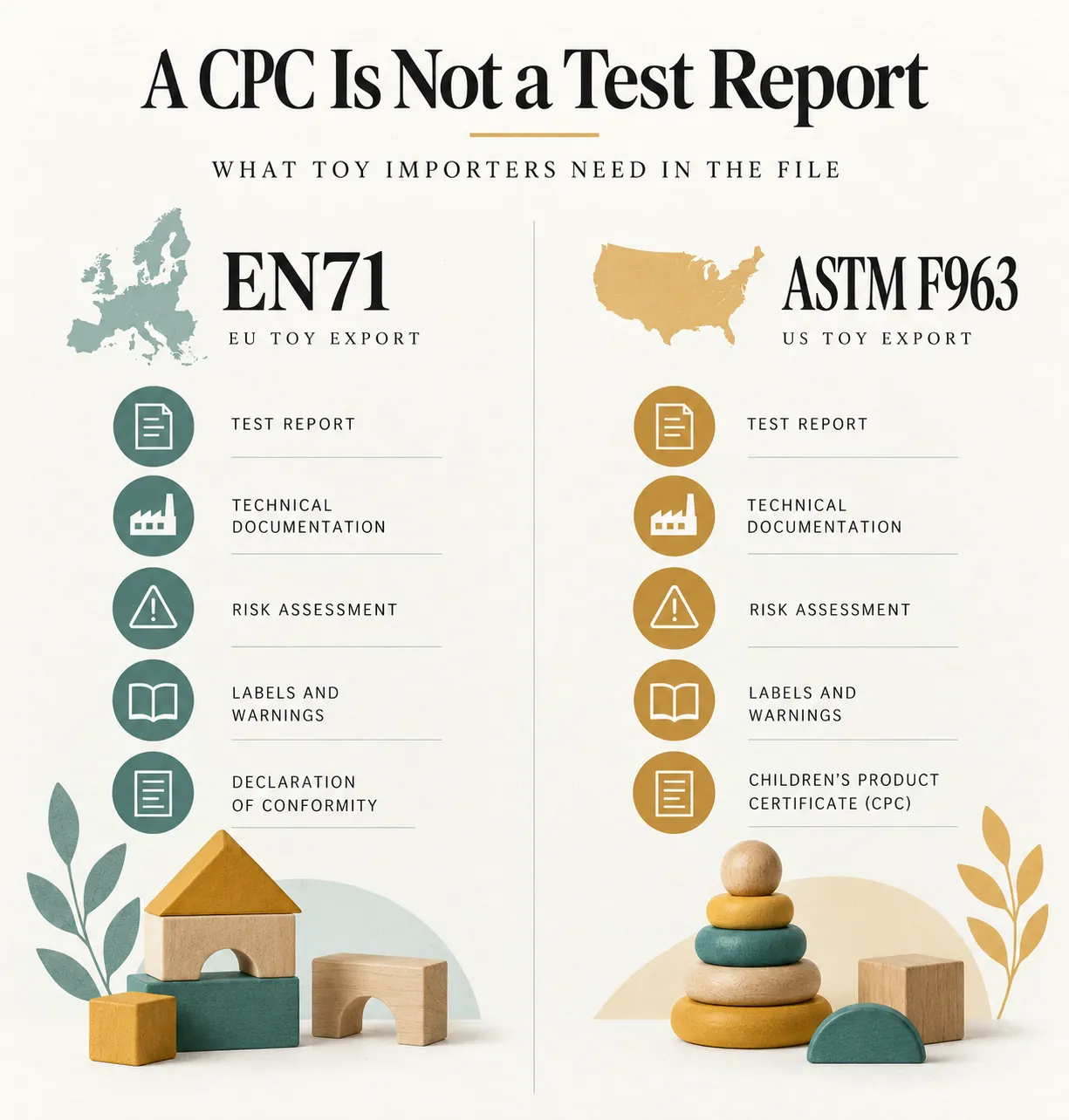
A Children's Product Certificate (CPC) is a written self-certification that the domestic manufacturer or importer issues; it is not a laboratory test report, and a test report alone does not satisfy the certification requirement. The CPC must be based on test results from a third-party, CPSC-accepted laboratory, and the certificate and its supporting reports must be in English. For a retail-chain buyer or compliance-led sourcing manager, the practical outcome is this: your file needs both documents, matched to the exact model and configuration you are buying — not a certificate covering the category and a report covering a sibling SKU.
SKU specific toy test reports are the evidence layer. The CPC is the declaration layer that cites them. Treat them as two separate deliverables with two separate owners, and your customs and platform review file gets much easier to defend.
Who actually issues a CPC, and who tests?
The manufacturer or importer issues the CPC. CPSC does not issue, approve, or register certificates. The lab's role is narrower and more technical: a CPSC-accepted third-party laboratory produces the test results the certificate rests on. If a supplier tells you the lab "issued the CPC," that is a terminology problem you should correct before the file goes to a buyer or a broker.
There is one exception worth knowing. Where a product falls under an exemption, exception, or a CPSC determination that removes the testing requirement for a specific rule, the manufacturer or importer must still create and issue a CPC, citing all applicable regulations and listing the exception or exemption claimed instead of a third-party laboratory. So "no lab on the certificate" is not automatically a red flag — it may be a correctly cited exemption. "No CPC at all" is a different matter.
Which products need a CPC — and which toys do not
CPSC testing and certification requirements apply to products designed or intended primarily for children 12 years of age or younger. ASTM F963 covers a wider age range, but that does not pull older-audience toys into the certification regime. Toys intended for a 13+ audience may still be subject to ASTM F963 requirements, yet they do not need third-party testing at a CPSC-accepted laboratory and their manufacturers and importers do not need to certify compliance in a CPC.
This is where age grading stops being a marketing field and becomes a document field. If your listing, packaging, or artwork signals a younger audience, expect the file to be read against the 12-and-under rule regardless of what the spec sheet says. Get the age grade settled before you commission testing, because it determines which document set you are building.
What the CPC must cite for a toy
For children's toys, the citation to use in section 2 of the CPC is "16 C.F.R. part 1250 – Children's toys," followed by a list of the applicable ASTM F963 sections. That structure matters: a certificate that names ASTM F963 in general terms without the applicable section list is not doing the job the citation field exists for.
If the toy bears paint or similar surface coatings, the certificate must also include "16 C.F.R. part 1303" in addition to the relevant ASTM F963 section. Painted and coated toys are common in plush, wooden, and die-cast assortments, so this is not a niche add-on — it is a routine line item on the certificate for a large share of toy SKUs.
The underlying mandate is not new. Section 106 of the Consumer Product Safety Improvement Act of 2008 made ASTM F963 a mandatory consumer product safety standard for children's toys, codified at 16 C.F.R. part 1250, with 16 C.F.R. § 1250.2 identifying the latest Commission-accepted version of ASTM F963 that is mandatory. See CPSC Toy Safety Business Guidance.
The document relationship, in one picture
Read the file as a chain, not a stack. The purchase order defines the model and configuration. The test report is generated against a sample of that model, by a CPSC-accepted third-party laboratory, in English. The CPC then declares compliance with the applicable rules, cites the regulations and the applicable ASTM F963 sections, identifies the issuing manufacturer or importer, and points to the lab and the testing date and location. The tracking label on the product and packaging closes the loop back to the physical goods.
Break any link and the chain fails at the weakest point, not the strongest. A perfect lab report with a certificate that names a different model number is a mismatch. A correct certificate with a report covering only the base material rather than the finished toy is a coverage gap. Buyers who audit by link, rather than by "do we have a CPC," catch these before a broker or a retailer's compliance desk does.
One more boundary: the EU framework is a different system. All toys sold in the EU must carry CE marking, which is the manufacturer's declaration that the toy satisfies the essential safety requirements, and the EU provides two conformity assessment routes — self-verification using harmonised standards, or third-party EC-type examination by a notified body. A CE declaration is not a CPC, and an EU test report is not a substitute for the US certification file. Keep the two market files physically separate.
Market and model document matrix
| Document | Children's Product Certificate (CPC) |
|---|---|
| Who issues it | Domestic manufacturer or importer — not the laboratory, not CPSC |
| What it is | Written self-certification of compliance with applicable children's product safety rules |
| What supports it | Test results from a third-party, CPSC-accepted laboratory |
| Language requirement | CPC and supporting test reports must be in English |
| Toy citation (section 2) | "16 C.F.R. part 1250 – Children's toys" plus the applicable ASTM F963 sections |
| Painted or coated toys | Add "16 C.F.R. part 1303" alongside the relevant ASTM F963 section |
| Age scope for testing and CPC | Products designed or intended primarily for children 12 years of age or younger |
| Toys for a 13+ audience | May be subject to ASTM F963, but no third-party testing or CPC required |
| When testing is exempt | CPC still required; cite the exception or exemption instead of a laboratory |
| Model matching | Certificate, report, product label, and listing must describe the same model and configuration |
| Configuration review | Compare the material, supplier and design with the tested sample before relying on the evidence. |
| EU counterpart (separate file) | CE marking plus either self-verification against harmonised standards or EC-type examination by a notified body |
A worked audit: three SKUs, three different failures
Take a three-SKU plush and painted-wood assortment and run the same five checks against each. The checks are proposed buyer criteria, not a compliance standard, and passing them does not guarantee clearance — they exist to surface mismatches early.
Check one: does the CPC name the issuing manufacturer or importer, with a full address and phone number? Check two: does the certificate's model and description match the report's sample and the product label? Check three: does the citation line read "16 C.F.R. part 1250" plus applicable ASTM F963 sections, and add "16 C.F.R. part 1303" where the SKU is painted or coated? Check four: is the report from a CPSC-accepted third-party laboratory, in English? Check five: does the report reflect the current configuration, including any material or supplier change since the original test?
The same discipline applies to the report layer. A type-test or golden-sample report does not automatically cover a later production lot, and test coverage must be assessed against the report sample and the exact model configuration — a standard name or a report for another model is not blanket evidence for the full catalog. If you maintain an inspection record, the useful fields are model or SKU, sample revision, lot, inspection date, inspector, observation, defect photo, disposition, and release authority. That is an operational template, not proof that an inspection happened.
Buyer questions on CPC files and test evidence
Can a supplier send only the test report and skip the CPC?
No. The report is evidence; the CPC is the certification. The manufacturer or importer must issue the CPC, and it must be based on test results from a third-party, CPSC-accepted laboratory. A report without a certificate leaves the certification obligation unmet.
Does the CPC have to be issued by a CPSC-accepted laboratory?
No. The laboratory produces the test results. The CPC is issued by the domestic manufacturer or importer. If a supplier says the lab issued the certificate, ask them to restate which party signed it.
What if the toy is exempt from third-party testing?
A CPC is still required. Cite all applicable regulations and list the exception or exemption claimed in place of the third-party laboratory for the rules that were not tested.
Do toys for teenagers need a CPC?
CPSC testing and certification requirements apply to products designed or intended primarily for children 12 years of age or younger. Toys intended for a 13+ audience may be subject to ASTM F963 but do not need third-party testing at a CPSC-accepted laboratory or a CPC.
Can we use one CPC across multiple SKUs in a family?
Only if the certificate and the supporting evidence genuinely cover each model and configuration. A certificate written for the assortment while the report sampled one variant is a coverage gap, and the remaining variants typically need their own evidence.
Does a CE declaration cover our US import?
No. CE marking is the manufacturer's declaration under the EU framework, which offers self-verification against harmonised standards or EC-type examination by a notified body. It is a separate market file from the US CPC.
When should buyers review the test evidence?
Material, supplier, or design changes can put the existing evidence out of date for that model. Treat any change to the tested configuration as a trigger to review whether the report still describes what you are shipping.
Sources
Audit the file before the broker does
Run the five checks above against your next purchase order, SKU by SKU, and keep the certificate, the report, and the product label in one folder per model. If you want a structured starting point for organizing model-level test documents, review the document set we maintain at SKU Test Documents and map it against your own PO before the next production run.
Put this into your procurement file.
Send the model, destination and approval scope to our team.
Request Audit Documents